Chapter 6: Prepping the Interior Walls for Removal

“Chipping Paint . . . What Could Be Better?!?!” Short answer “Just about anything.”

Now that we got the trailer snug into its garage, the timing is right to start gaining access to the annular space between the inner and outer shells. This will give us access to the insulation, power wiring and controls wiring . . . and, as it turns out, many other strange wonderful things (more to follow on later posts).

This is the part of the story where I could tell you that all those years chipping paint in the Navy finally paid off. However, as anybody who was in the Navy with me probably knows, I never actually chipped paint so I had no innate skillset to lean on. No time like the present . . .

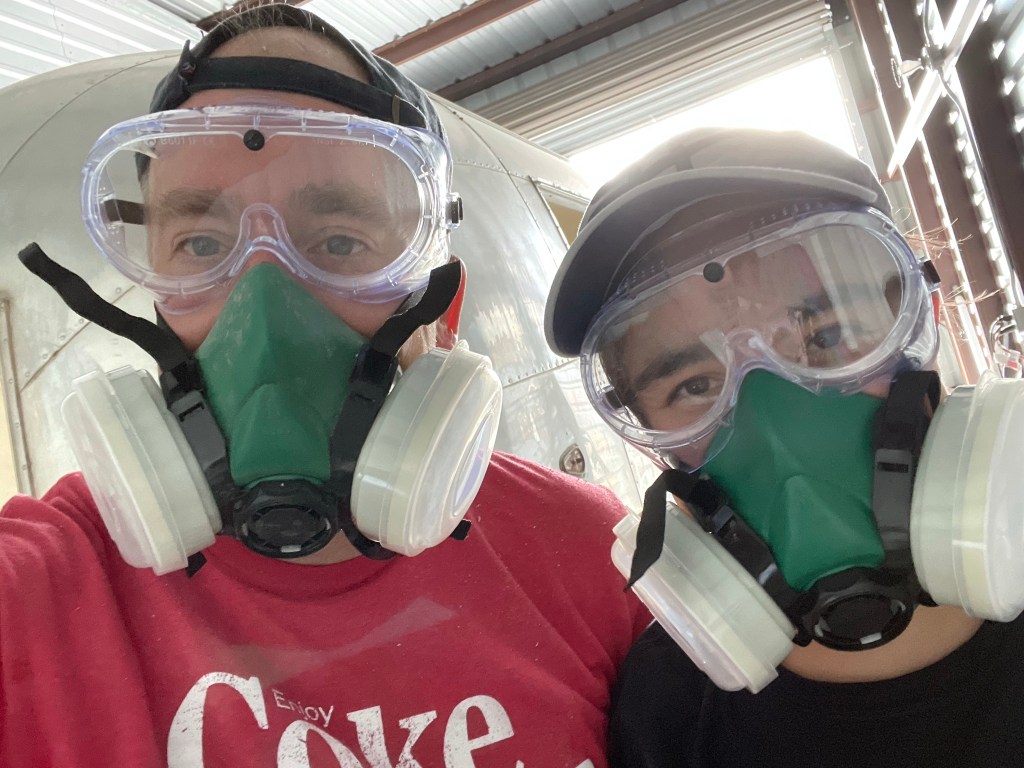
Primarily for economic reasons aimed at reusing the old aluminum panels, we decided to strip as much of the existing paint as possible before removing the panels.

This ended up requiring a little trial and error.

  1. First attempt: We applied paint solvent then tried to peel the paint . . didn’t work.
  2. Second Attempt: We tried an orbital sander . . . worked but very slow.
  3. Third Attempt: We tried a silicon carbide wheel attached to a drill . . . worked by kinda slow.
  4. Fourth Attempt: We tried a silicon carbide wheel attached to an angle grinder . . . Heck yea! Get some!

This is the interior right before we removed the interior wall panels and end bell pieces.

It took about a week to strip the paint and another few days to remove the panels. This 3D video gives a good look at the interior after we got done stripping the paint, but before we pulled the interior walls. Please excuse the disembodied feet.

Chapter 5: OK. You got it home, what now?

In my mind I was already rebuilding this grandiose super-cool, ultra-modern trailer with solar power, UV reflective windows and composite flooring. In reality I had no idea how to get from point A to point B . . . so we just got at it. Step 1 – try to figure out what you’re doing. Step 2 – do it. Step 3 – repeat step 1. . . .

I suppose step 1 of the rebuild started in New Mexico before we brought it home.

The first part of our rebuild was to empty and wreck out the interior. As you can see, in addition to 15 bags of stucco, it had some fine furniture, an ultra-modern beautiful utility sink, fine ply-wood trim and an state of the art hot water heater (complete with holes); all of which we kept for later reinstallation ;). The trailer had been used as a storage shed for literally decades and it needed to be emptied.

The Starting Point

Next we removed the top 3 layers of flooring to expose the sub-floor. This was to remove weight and give us something to bolt the driving controls junction box to (see previous post about electricity). The floor had tile, on top of grout, on top of a wire mesh on top of a plywood sub-floor. This was perplexing to me because it added a ton of weight and I couldn’t figure out why somebody would do this.

We later figured out that the original sub-floor had been removed and replaced piece-meal. Per the Airstream’s original design, the sub-floor was originally a structural member and it connected the frame to the shell (more details to follow in later posts). As structural member it was no longer intact and it was no longer attached to the frame. Somebody (probably my mother) over the years had replaced the original sub-floor with a ply-wood patch floor and then smoothed it out with the grout.

Once we got it home, we set about removing everything on the interior.

We found about $2.00 in change in the shelves, an old tablet of Benadryl and (my personal favorite) a 30+ year old stick of Wrigley’s Double Mint Gum! . . . and no we didn’t split it in two and have a bubble blowing contest.

Hey Bro, want some gum?

. . . and we’re done . . . ready to tackle the interior aluminum walls.