Engineering Analysis – Corrosion Mechanisms: Floor, Shell, Frame and Fasteners

When we took apart the frame, we were surprised to find the frame and fasteners were significantly corroded. The frame crossmembers underneath the vanity was paper thin, the fasteners which held the sub-floor the frame were so embrittled that they snapped off when we tried to remove them.

This was a little concerning to me since I wanted to understand the mechanism to prevent it from happening again.

Galvanic Corrosion: My initial thought was that the predominant corrosion mechanism was galvanic corrosion. Galvanic (or two-metal corrosion) occurs when two metals of different potential (affinity for electrons) are in electrical contact within a corrosive environment. Simply put, the more anodic (i.e., lower EMF metal – Aluminum in this case), gives up its electrons to the more noble metal (Iron in this case). The electrons travel to a place where they can react in an oxidation reaction.

In case you were not aware, Airstreams are constructed with Aluminum and Steel in physical contact with one another, setting the stage for galvanic corrosion to occur.

In Corrosion Engineering, Fontana discusses that galvanic corrosion usually occurs at the metal-metal interface with the corrosion occurring on the more anodic metal (Aluminum). Fontana also discusses a phenomenon known as the area effect in which a large anodic surface areas (e.g., large Aluminum shell) in contact with small cathode interface area (e.g., small steel bolts) will tend to slow the reaction.

In short, what I would’ve seen if galvanic attack was the source of the corrosion was corrosion of the aluminum at the Al-Fe interface. In fact, all of the corrosion I saw was of the iron components (bolts and frame). This indicates that the corrosive mechanism was not galvanic attack.

Now that galvanic was ruled out as a source of corrosion, I started to think about other mechanisms. Looking at the frame showed general overall corrosion with areas of greater thinning. In other words, the whole thing rusted but some areas were worse than others.

Uniform Attack (aka Rust): Per Fontana, uniform attack is the most common form of corrosion and is characterized by an electrochemical reaction that proceeds uniformly over the entire exposed surface. This was the case for most of the frame and it is assumed to be this was the primary source of corrosion.

Hmmm . . . why was the rust really bad in some spots, and not others? Doesn’t sound very ‘uniform’ to me!

Environmental Conditions Affecting Corrosion: You may be wondering why some areas corroded worse than others if the mechanism was essentially the same. The reason can be found in the abundance of oxidizers at the corrosion site.

The presence of oxygen and water will increase the oxidation reaction at the place where those chemicals can be found. The photos above show two such locations: The annular space between the inner and outer shell, and the frame area directly below the bathroom sink. Presumably the outer shell and piping to the sink both leaked.

Representative anodic reaction: Fe -> Fe2+ + 2e

Most likely cathodic reaction: O2 + 2H2O + 4e -> 4OH

Wood Rot: The old sub-floor was made of plywood. Plywood is also susceptible to damage relating to water exposure. However, in this case, it’s susceptible to water absorption, rot and molding. The picture below shows the joint between the sub-floor, c-channel and shell (near the door) and is representative of the wood rot that existed throughout the trailer.

Sub-Floor As-Found Wood-Rot

Corrosion Prevention: It’s unrealistic to assume we can stop all corrosion, but it is reasonable to assume we can slow it down to so that the trailer lasts another 57 years. Here is what we are considering.

  1. Prevent oxidation from occurring at the frame’s metal/air interface by removing that interface through the use of spray-on coatings (i.e., primer & insulation).
  2. Leak-proof the exterior shell. to prevent water from getting into the annular space
  3. Select insulating material which will not hold water (i.e., won’t hold oxidizing medium)
  4. Insulate the iron fasteners from the aluminum shell using gasketing material
  5. Allow for drainage in the shell annular space.
  6. Sacrificial anode (i.e., zinc anode, or zinc galvenization) of the frame so that when oxidation occurs, the metal giving up its electrons is not the steel . . . . or the Aluminum.
  7. Different sub-floor material which is not susceptible to wood rot and/or water absorption.

Engineering Analysis – The New Sub-Floor

One of our goals in the upgrade is to modernize the trailer and improve component reliability. One element of this upgrade effort was to improve the lifespan of the flooring. The old sub-floor had been replaced at least once and we were, I think, looking at the 3rd sub-floor when we started the rebuild.

Note: As you read this, please keep in mind that it is unique to a 1963 19′ Airstream Globetrotter trailer / sub-floor combination. Other materials, frame sizes and geometries will have different mechanical properties.

As you can see, it was rotted and in pretty bad shape.

As-Found Flooring Condition (rotted).

We determined early in the rebuild process that the original subfloor/fastener combination had a life span of something less than 57 yrs (see above).

For the new floor, we had three primary goals:

  1. First we wanted it to last pretty much forever
  2. It had to be cool . . . composite flooring sounds cool
  3. It had to last pretty much forever!

Putting the cart before the horse, We went after goal #2 first and bought 4 each 4×8 sheets of Composite boards for the new sub-floor. . . .afterwards we started to wonder if composite boards were such a good idea.

Now that we had leapt into the unknown and bought the board, we set about classic confirmation bias to prove to ourselves that the board we bought was indeed up to the job. Unfortunately, there was no readily available engineering analysis to reference, so Pete set about doing his own analysis using techniques he had learned while pursuing his Mechanical Engineering master’s degree at Texas A&M.

Side note:

MEEN 688 Advanced Solid Mechanics was a crushing but strangely enjoyable course. Imagine doing partial differential calculus with 3rd order tensors; all while 32 years out of your engineering undergrad! Pete had to re-learn how to use a calculator . . . much less all that math stuff.

The picture below shows the view of the sub-floor/frame combination showing areas of concerned where the subfloor is suspected of being insufficiently supported, either due to a lack of frame support or a panel joint between the sub-floor pieces.

Questions to answer:

  1. Will it last longer, or is it susceptible to mold, water absorption, UV radiation, . . .? (i.e., what are it’s corrosive properties?)
  2. Is composite board strong enough for this use?
  3. Is composite boarding a better choice than plywood?
  4. Do we need to install additional outriggers or cross members to the frame?

To answer #1 Pete did a little research. Plywood is actually stiffer (i.e., should deflect less), but it is susceptible to water absorption, rot and mold. Composite boarding is susceptible to UV radiation, but won’t absorb water, rot or mold. Conclusion: composite board will last longer if you can protect it from UV radiation, edge effects and if it’s adequately strong . . . which leads to question #2.

To answer #2 Pete did multiple iterations of engineering analysis. First by hand-calculating modeling analysis of small sections of the floor and then validating those calculations using engineering modeling software.

Hand Calculations: Fitting for a 1963 Airstream, we found an engineering reference from 1959 entitled Theory of Plates and Shells, which, albeit in a circuitous and confusing manner, provided sufficient technical guidance to model the sections of the floor encircled in red above. In the absence of computers in 1959, problems like this one were tackled piecemeal using finite sub-sections, formulas and look-up tables. One such analysis was the modeling of the center, left rectangle above (scenario 1). This section was modeled as a plate, clamped on 3 sides with one free edge.

The snip below shows an excerpt of the types of formulas contained in the 1959 reference.

Scenarios 2 and 2a were modeled using a method described in Theory of Plates and Shells to model overhanging floors and resulted in only deflection calculations (i.e., how much will it move up or down), but not stress. Stresses were approximated by correlating deflection with principal stresses, but this was done with low confidence.

Computer Calculations: A computer modeling simulation was next performed on the same geometries as the hand calculations. Scenario 1’s results were very close to the hand calculations. . . 🙂 . . ; while scenarios 2 and 2a results were of the same order of magnitude . . . meh.

Scenario 1 Computer Simulation
Scenario 2 and 2a Computer Simulation

That’s cool. It looks like it will work. The final step in the engineering analysis was to model the entire assembly (4 plates on the frame) to determine if a laminar coat of fiberglass was need for stiffness.

The final analysis of the sub-floor was done with computer modeling to determine the maximum stresses and deflection with and without a re-enforcing fiberglass layer. The modeled deflection went from about 1/2 ” at the cantilevered overhangs (scenarios 2 and 2a) without re-enforcement to nearly zero with a re-enforcing fiberglass layer.

Bottom line: The sub-floor should pretty much last forever as long as it is not exposed to UV radiation for extended periods of time AND the sub-floor will be sufficiently stiff if we use 3/4″ composite boarding with fiberglass re-enforcement.

Chapter 1. The Beginning

Before we get into the details and day-to-day (or rather, after-hours, weekends, etc) of this grand adventure of Pete & Stef’s first Airstream rebuild, I wanted to share the back story of how this idea began. Besides, it is an opportunity for me (Janet, wife to Pete and mom to Stef) to contribute. Tim, our son, is a budding graphic artist and he has created our icon, “Shirley (re) Creations (a mini size and full size version). While Pete and Stefanie will likely be the ones doing the lion share of the work, Tim and I will contribute albeit more infrequently.

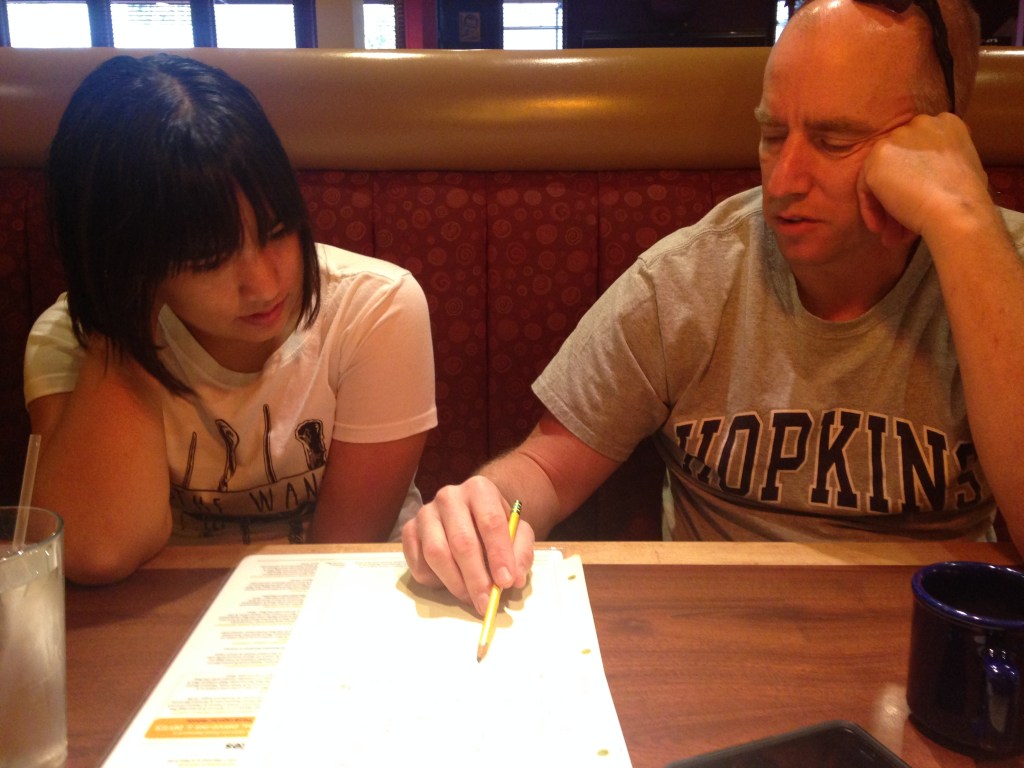
But back to what got this going. When Pete and I met in 1989, Pete’s mom was already living in northern New Mexico. For as long as I can remember, on her property sat an old Airstream which was being used as a pseudo-apartment. Who would have thought that it was essentially a “tiny home” before it was chic! In any case, over the years that trailer fast became a storage area and fell into disrepair. Still, Pete occasionally would talk about the possibility of refurbishing/renovating the trailer. As the kids grew older, and Pete and the kids went to New Mexico each summer to meet up with his side of the family, the subject kept coming up. Just as Stefanie prepared for graduation from Johns Hopkins, she too started expressing interest in the idea of rebuilding the Airstream. Part of the desire was a better and safer place to store their bikes to visit other trails across the nation; in fact, I have put a few photos of those New Mexico mountain biking excursions down below. One picture shows Pete helping Stefanie with a class she was taking as she was obtaining her degree from JHU. It was so fun to watch the two working together.

More recently, Pete shared with me his motivation for rebuilding the trailer and I was surprised to find that his motivation stems pretty far back: as far back as when he graduated from the University of Maryland and began his career as a nuclear-trained submarine officer (around 1985-1990). This career path was pretty intense; it entailed one year of school-based training followed by two years of technical qualifications overlapped by four years of hands-on operating experience onboard a nuclear-powered submarine. He learned about every “shipboard” system (e.g., micro-circuitry, low voltage controls, power distribution, hydraulic systems, rotating and fixed equipment and more!) during his time in the Navy.

While the idea of having a trailer to house his and Stefanie’s prized mountain bikes was one of three reasons to rebuild the trailer, he also wanted to expand on his past engineering experience while learning more about design. Additionally, he thought it would be cool to expose Stefanie to another, more hands-on aspect of engineering. Another bonus: getting friends and other family involved in what he viewed as a fun project (and yes, you may hear or see them on this blog on occasion!).

And so, after months (and really, years) of talking about it, our weekends and free time will be living it! We hope you enjoy our blog and this journey.